
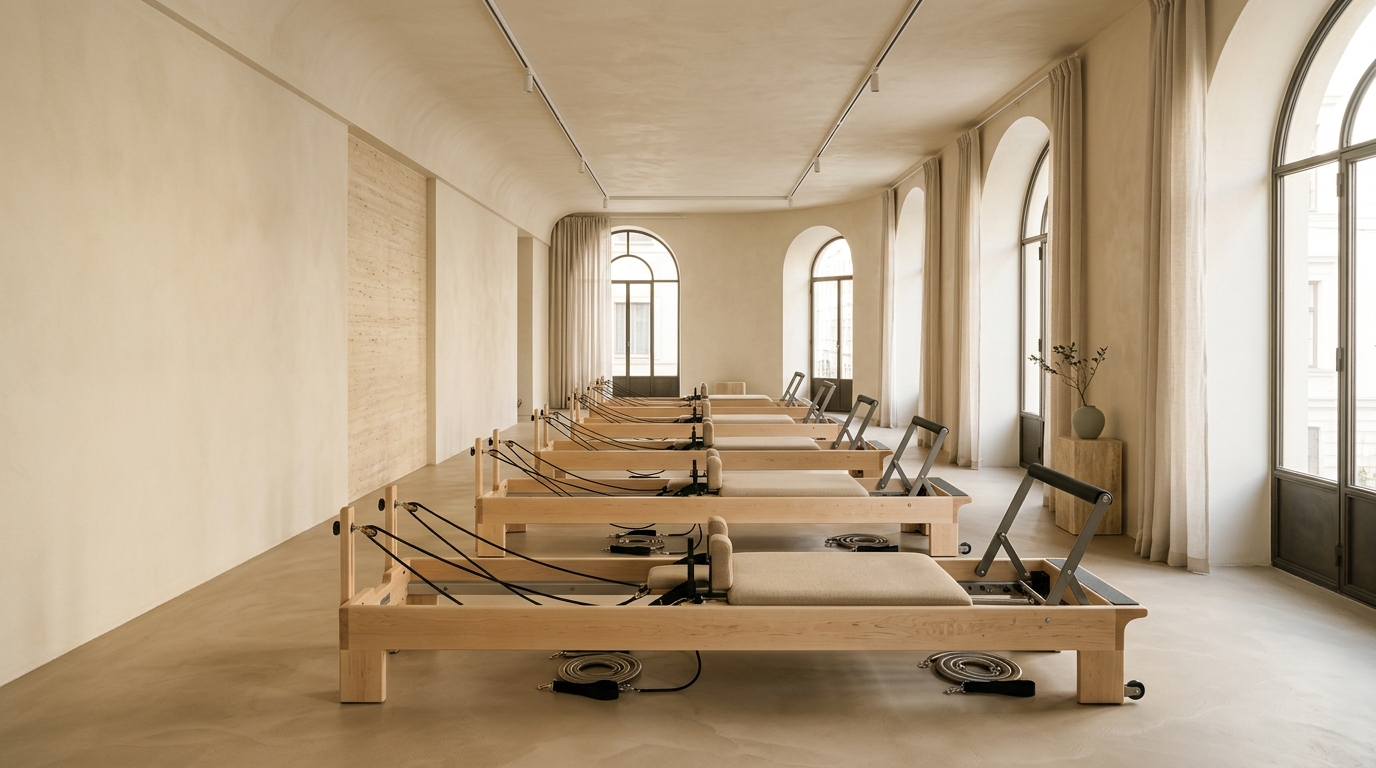
Short answer: Most new Reformer Pilates studios do not fail because demand is weak — they lose margin by launching with too many half-empty classes spread randomly across the day. A disciplined commercial timetable starts at 32 to 42 weekly classes anchored tightly in peak commuter hours (06:00–09:30 and 17:00–20:00), protects a strict 15-minute cleaning and spring-reset buffer between sessions, fills midday troughs with specialty Tower, prenatal, or senior formats, and adds new time slots only once existing classes hold above 75%–80% four-week fill rates.
Why timetable discipline beats bigger ad spend in year one
In a commercial studio, instructor pay is your largest variable operating expense after rent. Running a 10-bed Reformer class with three booked members at 2:00 PM generates barely $85–$105 in revenue against $65–$90 in instructor wages and software fees — leaving zero contribution toward rent or equipment payback while making the room feel quiet and low-energy.
Consolidating those same bookings into fewer, well-timed slots raises average occupancy from 48% to 72%, creates waitlists that reinforce membership urgency, and cuts wasted instructor payroll by $1,800–$3,200 per month. Before locking your opening schedule, model exact class volume, average ticket, and break-even occupancy in our Studio ROI & Payback Calculator and review full room P&L numbers in our Pilates Studio Profitability Guide.
Proven weekday & weekend timetable blueprint (50-minute class + 15-minute reset)
The sample schedule below works cleanly for a single-room 8-to-12 bed commercial Reformer studio in Australia, the UK, Europe, or North America, delivering 46 weekly group classes plus dedicated private/rehab windows without exhausting your teaching team:
| Time Block | Mon / Wed / Fri | Tue / Thu | Saturday / Sunday |
|---|---|---|---|
| 06:00 – 06:50 | Dynamic Flow (All Levels) | Athletic Strength & Jumpboard | Closed (prep for 07:30 start) |
| 07:05 – 07:55 | Signature Reformer | Signature Reformer | 07:30 – 08:20 Signature Reformer |
| 08:15 – 09:05 | Core & Posture Foundations | Sculpt & Burn Reformer | 08:40 – 09:30 Athletic Flow |
| 09:25 – 10:15 | Postnatal / Gentle Mobility | Open-Level Reformer | 09:50 – 10:40 Signature Reformer |
| 10:45 – 12:15 | 1-on-1 Privates / Clinical Rehab | Small-Group Tower / Chair Circuit | 11:00 – 11:50 Stretch & Mobility |
| 12:30 – 13:20 | Express 45-Min Lunch Reformer | Express 45-Min Lunch Reformer | Teacher Training / Workshop / Closed |
| 13:45 – 16:30 | Private Duets, Rehab & Studio Maintenance | Active Seniors / Intro Orientation | Afternoon Maintenance / Deep Clean |
| 17:15 – 18:05 | Signature Reformer (Peak) | Dynamic Flow (Peak) | Sunday 16:30 Candlelight Stretch |
| 18:25 – 19:15 | Athletic Reformer (Peak) | Signature Reformer (Peak) | Closed |
| 19:35 – 20:25 | Stretch, Mobility & Spine | Foundations / Beginner Reformer | Closed |
Protecting peak windows: why class level labels decide waitlist speed
Across almost every suburban and CBD studio, 65% to 75% of weekly class revenue happens inside three compressed windows: weekday mornings (06:00–09:30), weekday evenings (17:15–20:15), and Saturday/Sunday mornings (07:30–11:30).
A frequent rookie mistake is placing hyper-niche formats — such as “Level 3 Advanced Only” or “Prenatal Only” — inside prime 07:15 AM or 18:15 PM slots. Niche prerequisites block 70% of your active member base from booking your highest-demand hours. Keep prime commuter slots programmed as Open-Level Signature or Scalable Athletic classes where experienced instructors layer spring progressions and regressions cleanly, and route niche or clinical cohorts into 09:30 AM, midday, or 19:35 PM slots.
Monetizing 10:30–16:00 midday troughs with Towers, privates, and club partnerships
Rent runs 24 hours a day even when commuters are at their desks. Instead of discounting standard group classes heavily at 11:30 AM — which trains members to leave full-price memberships — build four midday revenue layers that match who is actually free between 10:30 AM and 4:00 PM:
- Small-Group Half-Trapeze Tower & Chair Sessions: Upgrading 2 to 4 floor beds to a Commercial Reformer with Tower opens higher-ticket 4-person specialty clinics at 11:00 AM without giving up a single peak group Reformer seat at 07:00 AM.
- Postnatal, Active 60+ & Referral Rehab Blocks: New parents, retirees, and physiotherapy referrals actively prefer quieter late-morning rooms with calmer music and slower transitions.
- 45-Minute Express Lunch Reformer (12:30 PM): Essential in business districts and mixed-use gyms where nearby office workers can arrive, train 45 minutes, and return inside a strict 60-minute break.
- Independent Contractor / Club Off-Peak Licensing: In multi-use health clubs and racquet centers, off-peak rooms can host sport-specific mobility sessions for tennis, padel, or golf members. See how multi-sport venues structure schedules on our Gyms & Padel Clubs Solution page.
Why a strict 15-minute turnaround buffer protects hygiene, equipment, and retention
Squeezing back-to-back 50-minute classes with only 5 or 10 minutes between start times looks profitable on a spreadsheet — adding one extra evening class per day. In real studio operations, 5-minute turnarounds cause four cascading problems:
- Rushed carriage sanitizing: Disinfectant spray needs dwell time and wiping; wet vinyl greets the incoming class and leaves a cheap impression on $35-per-class members.
- Lobby congestion & late starts: Ten outgoing members changing shoes while ten incoming members grab grip socks bottlenecks small boutique lobbies, clipping 4–6 minutes off every subsequent class.
- No time to greet first-timers or check injuries: Instructors need three calm minutes before class begins to brief newcomers on footbar locks, carriage springs, and shoulder blocks — preventing awkward interruptions once music starts.
- Missed hardware checks: A 15-minute window gives instructors 60 seconds to spot a twisted rope, loose jumpboard screw, or uneven spring hook before the next client clips in.
Instructor shift blocks: keeping teaching quality sharp without burnout
Scheduling isolated single classes (one 07:00 AM class and nothing until 12:30 PM) makes recruiting experienced Pilates instructors almost impossible — top teachers refuse unpaid commuting for one class fee. Group your schedule into clean 3-class morning shifts (06:00–09:15) and 3-class evening shifts (17:15–20:30) so one instructor earns a worthwhile shift payout in a single trip while maintaining crisp cueing energy.
Cap single-instructor blocks at 4 consecutive classes maximum; vocal fatigue and spotting attention drop sharply in hour five, especially in 12-to-16 bed rooms. For your full launch checklist covering hiring, permits, lease negotiation, and container delivery, read How to Open a Reformer Pilates Studio.
Frequently asked questions on Pilates studio class schedules
How many classes per week should a brand-new 8-to-10 bed studio launch with?
Launch lean at 28 to 35 weekly group classes focused squarely on weekday mornings, weekday evenings, and weekend mornings. Aim for 75%+ average fill across your founding timetable before opening additional slots — adding classes into full waitlists is easy, whereas cancelling empty classes hurts member confidence.
Should classes be 45, 50, or 55 minutes long?
Fifty minutes is the global commercial sweet spot: long enough for warm-up, balanced full-body programming, and cool-down, while leaving a clean 15-minute turnaround inside a 65-minute cycle (or 10 minutes on exact hourly starts). Reserve 45-minute formats for express weekday lunch classes.
How does bed count (6 vs. 10 vs. 16 beds) change the ideal class schedule?
A 6-bed studio generates lower revenue per class hour, so it must protect tight instructor payroll and supplement group blocks with higher-priced Tower or private sessions. A 10-to-12 bed studio reaches break-even with fewer total weekly classes, while a 16-bed athletic studio typically adds a dedicated front-desk host during peak shifts so the instructor stays focused purely on teaching and form cues.
Summary: engineer your room count and timetable together before ordering beds
Equipment count and weekly timetable are two halves of one business model. Launch with concentrated peak 3-class shifts, guard your 15-minute turnaround buffer, fill midday hours with Tower, private, or targeted demographic classes, and scale weekly slots strictly off real waitlist demand. Test how your planned bed count and weekly class volume affect monthly profit and equipment payback inside the Studio ROI & Payback Calculator.
Model Your Weekly Classes, Bed Count & Payback Months
Plug your planned bed count, weekly class schedule, ticket price, and rent into our live ROI model — or check floor capacity in the Studio Planner.
Leave a Comment or Ask a Studio Question
Only your email address is required (never published). Your note is forwarded straight to our team for review and email follow-up.